

No turning back now. The nomination period for Toronto’s 2026 municipal election ended at 2 p.m. Friday. By the numbers, we’ve got 53 people running for mayor and 190 running for Council. There are also some people running for school board trustee, probably.
There are no take-backs. Candidates can suspend their campaigns between now and October 26, but their names will remain on the ballot regardless. The field is locked.
So, uh, who’s going to win? Since City Hall Watcher’s attempt to develop a time machine is still stuck in a prolonged community consultation phase — some residents have requested additional temporal traffic studies — we can’t say for certain. But we can offer you the next best thing: a projection.
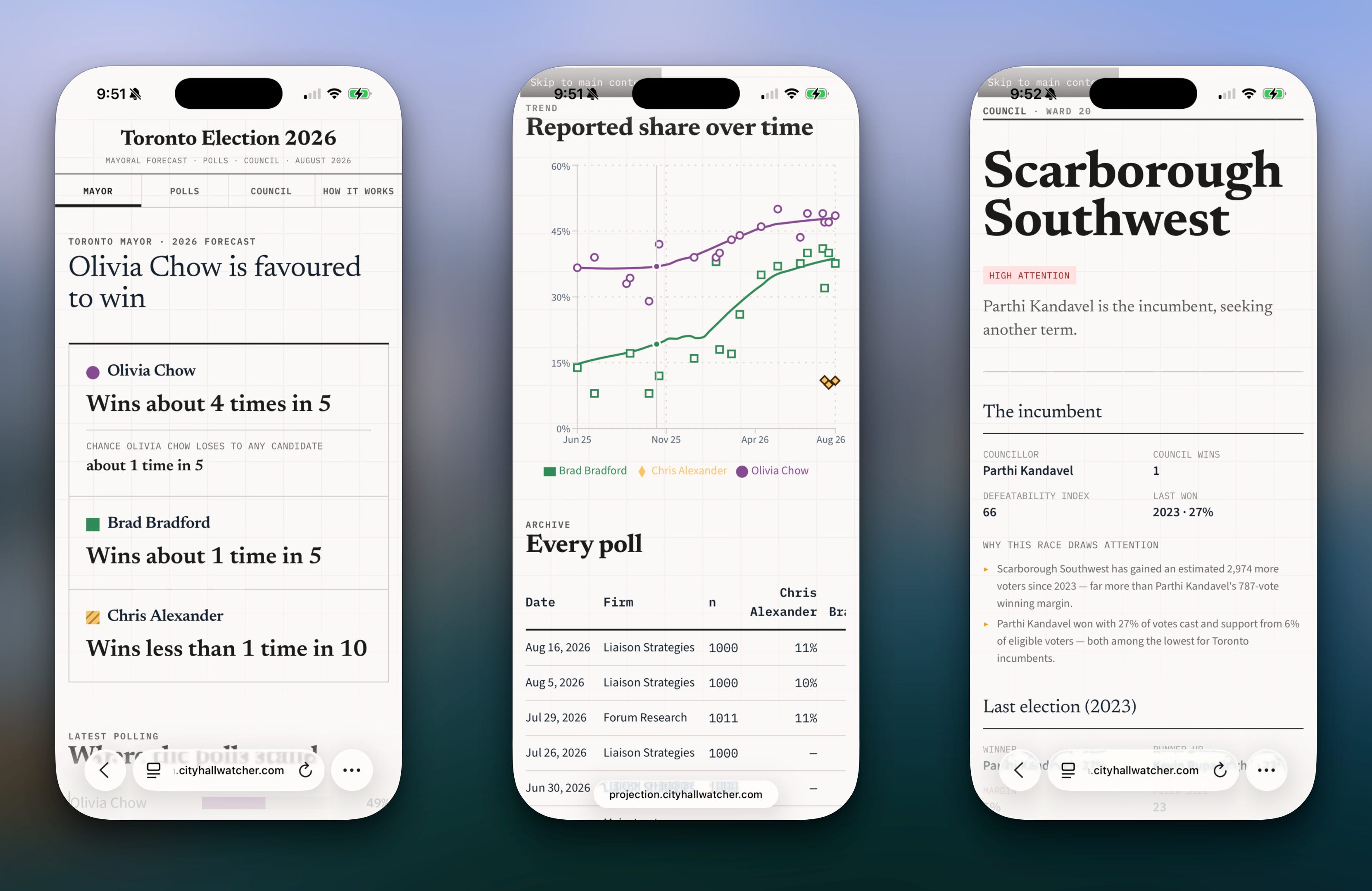
Today, City Hall Watcher is launching its first-ever official Election Projection. In collaboration with Alex Olson, Director of UofT’s Centre for Analytics & AI Engineering, the project will live at projection.cityhallwatcher.com.
The projection site includes:
Current odds for the mayoral race for the three major candidates: Mayor Olivia Chow, Councillor Brad Bradford, and Chris Alexander.
An overview of all 25 Council races, with a selection of races to watch based on a whole bunch of factors.
Read on for Alex’s more detailed introduction to the projection project and various nerdy details.
Also in this edition of City Hall Watcher: your final Council Scorecard update of the term, with some housing data updates, and a look at all the last-minute drama in the mayoral race. Surprise retirements! Ward switcheraroos! It was a weird week.
Let’s get into it.
— Matt Elliott & Andrey Levkovski
matt@cityhallwatcher.com / andrey@cityhallwatcher.com / Archives / Subscribe
Building an election projection project
By Alex Olson
When it comes to predictive modelling, there’s a standard rule-of-thumb that the best model is as simple as you can make it without sacrificing capability. For Toronto elections, that means there’s almost no reason to stretch our model past “if there is an incumbent, they will win” — that alone nets you an accuracy rate that would make Nate Silver jealous (94%, in case you’re wondering).
Despite this, and perhaps motivated slightly by the fact that many wards seem to contain multiple candidates I’d call “incumbent-shaped”, I’ve been interested to see what useful information we can surface to help you follow this election.
For the Mayoral race, this is reasonably straightforward. There is a decent record of polling since amalgamation1, which means we can build a model and test if it works historically. My approach draws potential outcomes from a statistical distribution centred on a balanced average of polls, with the range of that distribution calibrated against the accuracy of past Toronto polling. We then draw thousands of outcomes and aggregate to see how often each candidate wins.
I still want to make sure that the model is worth something, though. To do that, I set a series of tests that my approach must meet before we show it anywhere. They fall into two categories. First, does the model beat just looking at the last poll before the election? And second, does it make approximately the same predictions even if we jimmy things around a bit? For the mayoral election, the answer is yes! What we’re showing you does a better job than the polls alone, and it’s sufficiently stable.
Council races are a different story. There are next to no polls done at the ward level, and where they do exist, they’re few and far between. This means we can’t tell you who will win2. However, there’s still useful information out there. In particular, I looked at past election performance across all tiers of government in Toronto – from school board to federal — to identify signals that rise above noise. This is presented alongside Matt’s own Councillor Defeatability Index, as well as what little polling does exist.
In all, I hope the Election Projection gives you the ability to better understand which races are being meaningfully contested, even if we can’t tell you who is most likely to win.
During the election period, I’ll be updating the model periodically and providing quick updates on changes as we see them. I hope you find the site useful — reach out if you have questions.
➡️ View the 2026 Election Projection
Alex Olson is the Director of UofT’s Centre for Analytics & AI Engineering, where he leads applied research, education and partnerships around AI. He helps people assess where AI can safely contribute, as well as to understand its limitations and risks. Alex has worked with climate scientists, surgeons and air quality researchers to reliably and accurately answer questions that require sophisticated modelling.
Council Scorecard Update: checking the final score for the 2026 term

By Matt Elliott
The Council Scorecard is my ongoing tracker of how often members of Council vote with the mayor on significant items.
Now with its very own fancy-pants web app, I add votes I deem significant after every Council meeting. Votes are considered significant if they’ve attracted a lot of public interest or are particularly indicative of a major ideological or political split amongst members of Council.
As a City Hall Watcher subscriber, you can access the Scorecard at CouncilScorecard.ca, with this brand new passphrase:
