

It’s a time of great change. The next Council term doesn’t officially kick off until this Sunday, but councillors elected last month have been sworn in.
Some initial notes! Will Curran Stikuts be the tallest councillor in the City’s history, as his swearing-in photo suggests, or does he just have short supporters? I’ll report back. Diana Chan McNally got a fist bump from retiring Councillor Gord Perks after signing. We’ll see if it passed along any of his penchant for fiery speeches. Also posing for photos with celebrity City Clerk John Elvidge: Chiara Padovani, Michael Thompson, Shaun Chen, Amber Morley and probably some others I missed.
To help get the sworn-in councillors — and the rest of us — ready for the new term, I’ve got a special guest today. Prolific City Hall idea generator George Bell has put together a list of eight things that could improve Council over the next term. Everything from procedural changes to a ban on driving while attending Council meetings. It’s a good list.
Also: Premier Doug Ford’s speed camera ban is one year old this week. Let’s check in on how speeding traffic has changed.
Let’s get into it.
✨ This issue runs a bit long. If it gets cut off in your email client, read it on the web.
— Matt Elliott
matt@cityhallwatcher.com / Archives / Subscribe
Eight rule changes that would make this term of Council better
By George Bell
It’s time — a new Council session is upon us. Excitement is in the air. The mayor has a new mandate, full of promises (although maybe not as many as supporters would have liked). New councillors will bring new personalities and new ideas to the City. A new speaker will provide flow and tonal changes to Council business. New committees will dig into the challenges facing Toronto. It’s all very exciting — especially for all of us civic nerds!
Before Council gets too far into all that, though, it’s worth taking a few minutes of self-reflection about the last four years and considering if there are any improvements they could make up front to the functioning of our local government.
As with any government, there is a need to update our rules and procedures from time to time. Improving governance, closing loopholes, making better use of technology and ensuring that we focus on what’s important.
Council has occasionally put forward a few rule changes at the beginning of new sessions to patch up some of the issues that have cropped up over the previous session. Some of these smaller changes often happen in the first few meetings of Council and have in the past included changes to make virtual participation permanent, creating deputy mayors and minor delegation of Vision Zero items. In some cases — like when the province imposed changes to Council size — entire sub-committees have been created to work through all the changes required.
So with that precedent in mind, I’ve put together eight rule changes and one bonus that I think would benefit this upcoming Council. If nothing else, they might make Matt’s job a bit easier over the next four years.
#1: No more driving during meetings
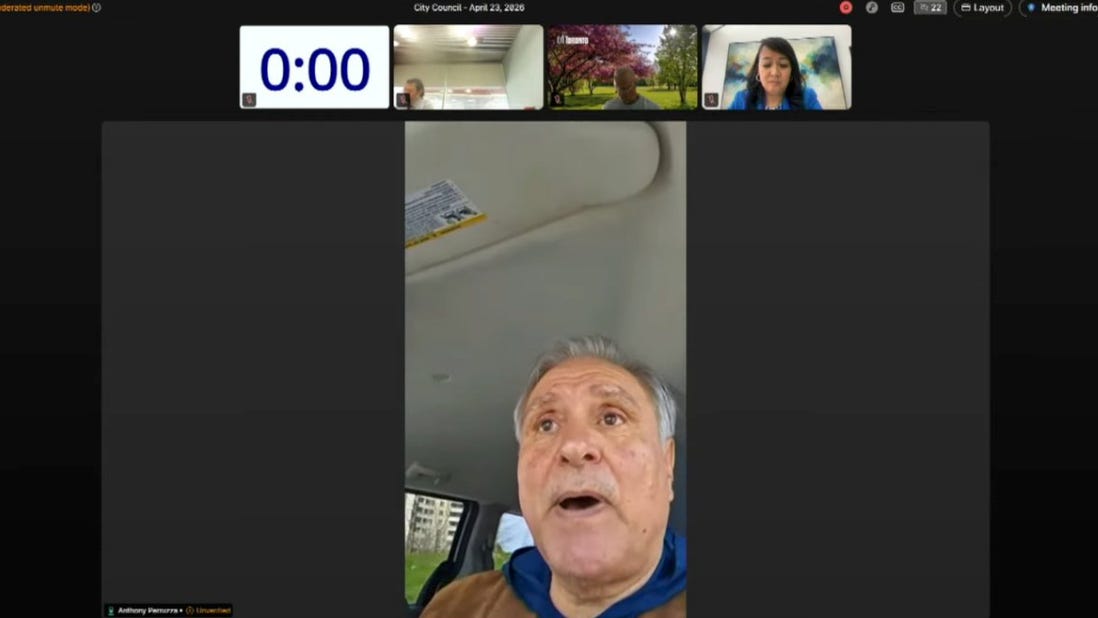
During the previous round of Council, there were at least three reported instances of councillors driving during Council or committee meetings. One of these even happened during a Council debate on a Vision Zero road safety item.
The province’s website on distracted driving states that “it is illegal to have a display screen visible to the driver that is unrelated to driving, such as a computer or video.”
Besides the obvious risk to the public, there is reputational and legal risk if an incident were to happen during a Council or committee meeting. Even if nobody is hurt, driving during Council is picked up by local news and becomes a major story the next day.
The rules around virtual access to meetings were put in place during COVID and made permanent in 2023. Some further guardrails are necessary to ensure that everything is happening in a safe manner.
A simple “Point of Community Safety” could be added to Council procedures. It would require the Clerk or Speaker to verify that the person on screen was not driving a vehicle and to prevent them from speaking until the situation was fixed. This would apply to councillors, deputants and staff.
I’ve been personally trying to see if there were other avenues to tackle this — by making an unofficial request to the Integrity Commissioner’s office. Unfortunately, without an HTA conviction in hand, they aren’t able to proceed with a Code of Conduct complaint.
#2: Report prioritization
There has always been a report black hole at City Council. It’s time to close it.
Starting in 2019, the Clerk began publishing a public report log. It has given structure and visibility to the reporting process. Prior to this, report requests were often forgotten by councillors and the public almost as soon as voting was complete.
But there is still a massive number of reports that never see the light of day.
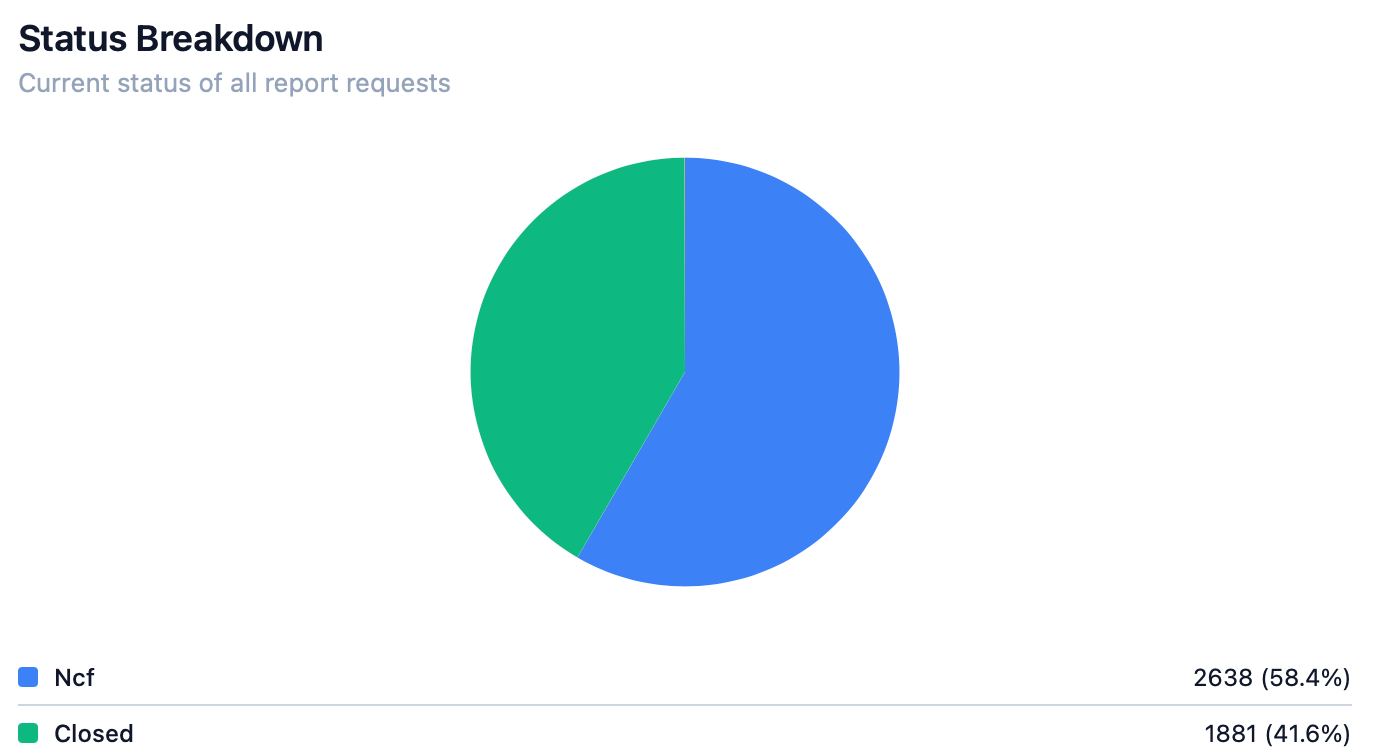
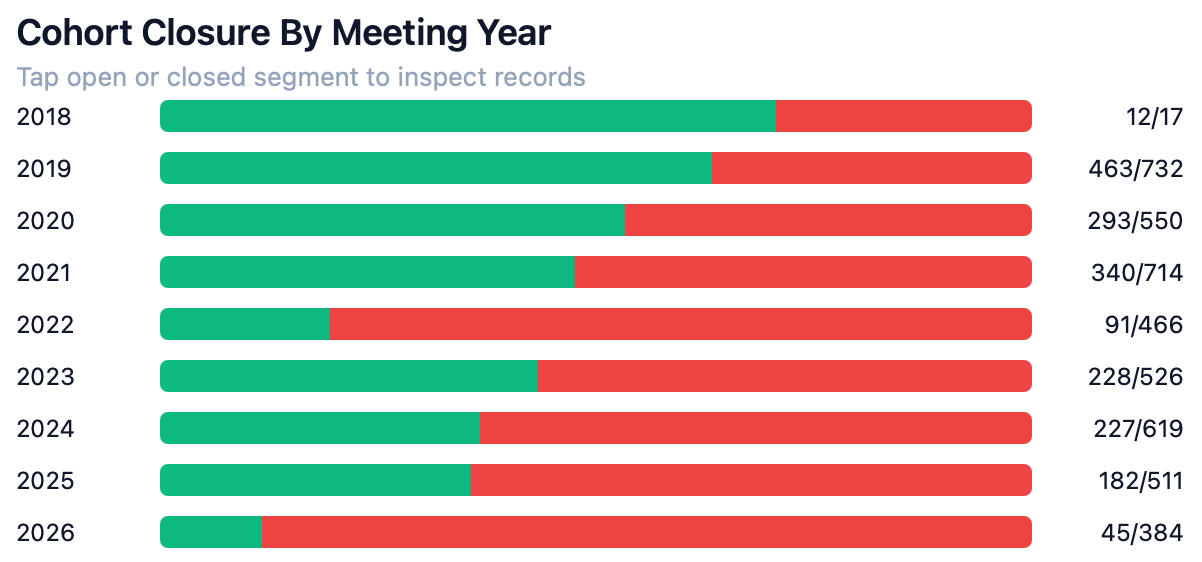
At the end of the 2018-2022 Council, all outstanding reports for that session of Council were tossed into the black hole. A few days ago, the same was done with the 2022-2026 reports. In City terminology, the reports are NCF (Not Carried Forward). No further work will be done on them, unless they are re-introduced at Council.
As you can see from the graphs, more than 58% of requested reports from 2018-2026 were never completed. Only about 12% of the reports in 2026 were completed.
Council needs to do some work to ensure that they are getting back a larger percentage of reports than they have historically.
Some potential avenues to improve this are:
hiring more staff to work on reports
requiring report requests to include language on priority, timing and scale/effort
putting upper limits on costs or staff time
providing Council with an array of report types that could be requested (brainstorm, options, detailed, third party)
requiring report features with long lead times and more staff time — like surveys, consultation or mailings — to be explicitly requested
It may also be worth creating a process where committees, Council or the mayor could change the priority or even eliminate report requests over time.
More data should be included in the report data sheet, including priority, timing, sizing, scoping, report type and long lead-time features. This will help future councils and the public better understand what is happening here.
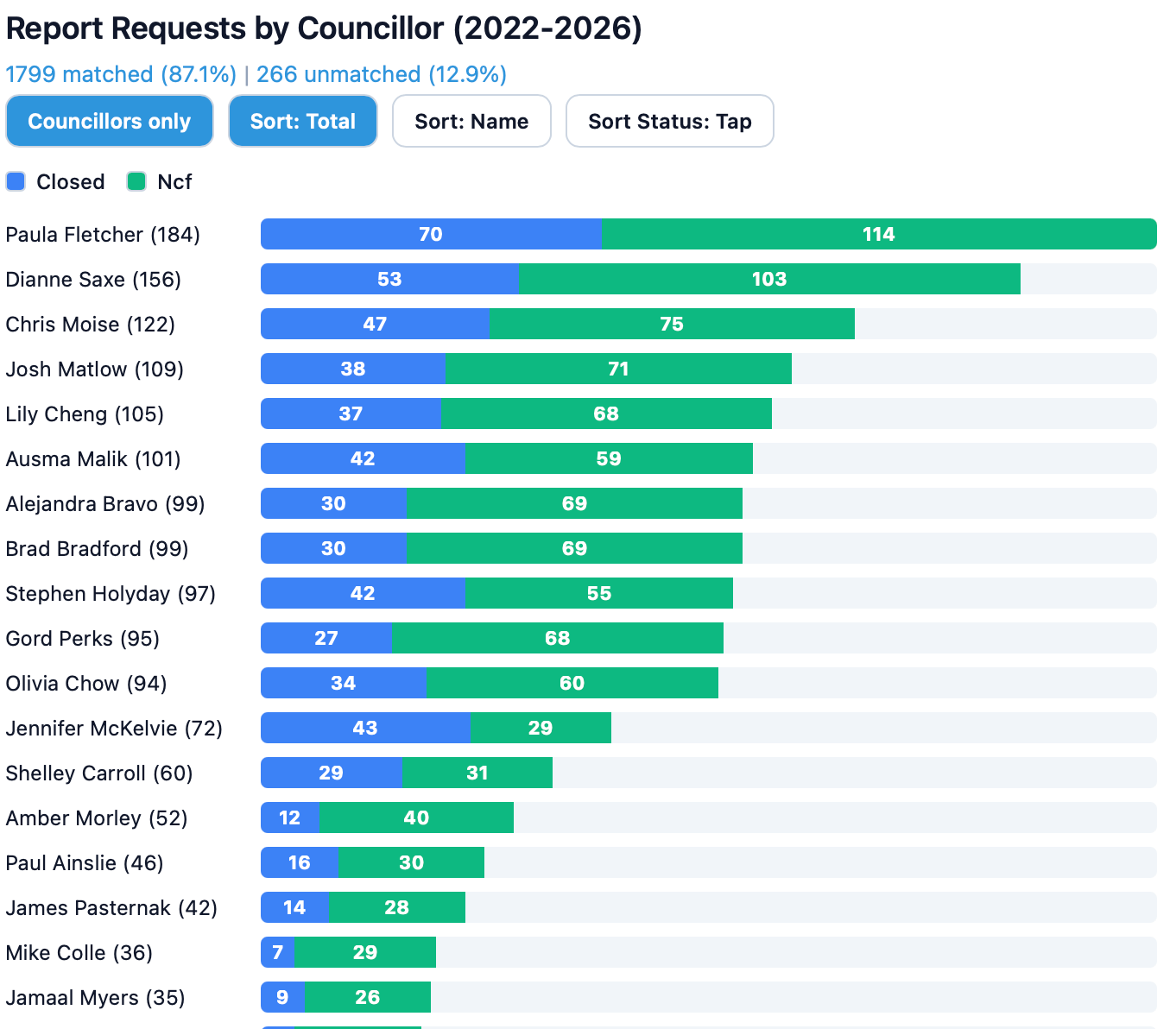
Finally, it would also be very helpful for the origin of report requests to be maintained, as there is some evidence that certain councillors and committees are less successful at getting reports returned by staff.
#3: Track official Council communications
While we are on the subject of black holes, a very similar thing happens to official communications from City Council.
Many items include directions to do things like “Ask the Province to change XYZ law” or “Ask Metrolinx to build ABC”. These official requests are sometimes delegated “Ask the Mayor to talk to…” or “Ask the City Manager to coordinate with…”. Sometimes these communications are emails, letters, or phone calls. Sometimes they are more in-depth conversations or meetings.
The end result seems to be the same, though: communications disappear into a black hole. Sometimes they return responses in future items, but often not. It’s often not clear if the communication was actually sent, and it can be challenging to track down what it contained, or who performed the communication. Communication trails can go dark as staff change.
And forget about finding out what the responses to these communications were. Even by FOI. Even just asking to confirm the communication was sent, or its contents, seems to result in dead ends or significant amounts of work.
An official communication log is one way to fix this. Initially, it would contain some basic information, a link to the official communication if available or meeting dates and attendees, and potentially the responses when it is reasonable to include them. More information could be added as the system matures (including confidential communications that only councillors could see).

This would add credibility to the City’s efforts to work with other levels of government, and help keep Council objectives in the public eye. It would also help City Council understand if further communication is needed, or if their request has been responded to.
FOI matters would also be simplified, as you could request all communications resulting from an item.
#4: Update time limits on deputations
Currently, deputations at committee are five minutes. However, if there are a lot of deputations on a specific day, this number is often lowered to three minutes by committee vote.
The problem this creates is that hot-button items with many deputations (often in agreement with each other — or even from the same organization) can reduce the time for everyone else, including lone deputants speaking on more obscure items.
Deputants who have planned for five-minute speeches must trim content in real time — often resulting in confusing speeches that run up against the time limit.
Further, there is an ongoing risk of large numbers of remote deputants causing havoc with meetings.
My proposal is to codify the time limits on a per-item basis instead of on a per-meeting basis:
If there are three or fewer deputants on an item: five minutes — in person or remote
If there are four or more deputants on an item: three minutes — in person or remote
If there are eight or more deputants on an item: three minutes — in person only
A further update would require the chair to hold a vote on ending deputations after deputation 12 and every eight deputations after that for each item.
#5: Pre-recorded video deputations
Council should allow for submission of video deputations (up to three minutes), and add improvements to TMMIS to allow these to be viewed and voted on.
The top-voted videos would be shown during breaks at committee and Council (on the live stream, and in the room). This would give the public an opportunity to comment, even if they have work or other commitments.
These could be creative and not just talking heads.
Some third-party work might be needed behind the scenes to ensure that videos meet community guidelines.
This would add an extra dimension to deputations by allowing everyone to participate. If the rules were extended to allow for councillors to play one or two selected videos during committee, it could potentially improve debate and bring in voices that are otherwise being excluded — a huge win for community involvement in government.
#6: Staff question day upfront
Senior Staff time is valuable, and Council has a habit of requiring many staff to hang around for large parts of Council in the off chance that they are needed for questioning. When they are questioned, it often feels rushed, with time limits imposed.
I propose that City Council implement a full day of staff questions, which would occur two or three days ahead of Council meetings.
Councillors would indicate prior to the meeting which items they had questions on, ensuring that the proper staff were in attendance. Questioning would proceed as normal, with second and third rounds of questioning available as time allows. The meeting would be time-bound to business hours.
There may be ways to further optimize this by pre-submitting questions and trying to maximize time on complicated items by getting simple ones out of the way first. Further rule changes could be made to limit questions on these items at Council.
#7: Eliminate the Speaker’s Member Motion boilerplate
A big chunk of every meeting is taken up by the Member Motions boilerplate — this is a repetitive, almost mantra-like series of statements by the speaker followed by a voice vote. At 15-30 seconds a piece, over sometimes hundreds of member motions, there seems to be an opportunity to simplify this system.
“MM43.111 this motion has been deemed urgent by the chair, this motion is not subject to a vote to waive referral, this motion has been added to the agenda before council for debate. On the item — all in favor of the item — carried.”
— Former Speaker Councillor Frances Nunziata, 138 (!) times at the last Council meeting of the 2022-2026 term
Some options: have a hold system for member motions, and bulk-add/approve any unheld item. Alternatively, batch them in groups of 10, or by the councillor who submitted them.
The challenge here is to get all the items added quickly, while ensuring that councillors have time to flag any as problematic.
#8: Create opportunity for deputations on items added at the last minute
There are a number of ways that Council and staff can get items on the agenda with little or no chance for the public to speak. Some ways include:
Member motions, because deputants can’t speak at Council
Any new business from staff at Council, because deputants can’t speak at Council
Any business added less than 24 hours before a committee meeting
Any business added after the committee meeting has started
In some cases, it seems that there is an abuse of this, as councillors or staff get to avoid having the public speak on items by submitting them at the last minute.
We saw signs of this in July, when hundreds of speed-calming projects had been added to Community Council agendas at the last minute. Clearly not an emergency, and much of the work was likely ready long before the items were submitted. Making this even worse: many of these items were delegated to those Community Councils, so they didn’t even get a second vote at Council. The short timing combined with a single vote is not ideal.
It would be wise to require any item added less than five business days before the meeting to have deputations at the next meeting when requested by the public.
For member motions and last-minute business at Council, deputations should be held at the next Executive Committee meeting, if requested by the public.
This reduces the incentive to submit items at the last minute and ensures the public gets their say on all items.
Bonus: Develop policies for AI submissions, AI deputations and agentic voting
It’s likely that during this term of Council we will have to reckon with AI deputants. Maybe even an AI Councillor, Mayor or Staff member. We likely have already had many AI submissions via email, and maybe even in some staff reports. AI use in the election was real, but so far seemingly innocuous.
But what happens when AI agents start reaching out to staff in a coordinated way, or your councillor gets their AI doppelgänger to stand in at Council while they are on vacation (or driving!)? What if the next consultation on zoning is flooded with extremely knowledgeable bots from a development company?
Some AI use will be necessary, but we’re going to need to make sure our systems are safe and up to date. Faster and more accurate responses from 311 or your councillor’s office would be great.
But where is the line drawn? Can an AI agent vote instead of a councillor? Can it talk to constituents? We need to start figuring this out and codifying some of it — while leaving some questions unanswered and allowing experimentation to take place.
It would be good to have a subcommittee with some experts in the field giving the City some ideas, pointing out risks and working on finding good places to integrate AI into our system.
I’m not proposing any rule changes here at the moment, but we need to be ready for some if things get out of hand.
So that’s my eight rule changes for the 2026-2030 term of Council. I hope you enjoyed reading. I’d love to hear your ideas as well; feel free to find me on X (@georgebell) or Bluesky (@george.borkbork.ca). And while it’s not relevant to Council procedural improvements, my passion project is getting platform doors on the subway during this term of Council — follow @ttcdoors on X!
— George Bell
Thanks to George for his contribution! I’m currently accepting freelance pitches for 2027. All contributions are paid, and paid promptly. If you’re a writer with an idea for some City Hall analysis or reporting, get in touch.
And if you want to help support this kind of independent journalism, become a paid subscriber. It costs just six bucks a month or sixty dollars per year — a bargain and a deal.
— Matt Elliott
