

Welcome to the 399th edition of City Hall Watcher. It’s the one before the milestone celebration.
But there’s still reason to get excited. In this issue, Andrey’s got answers to a question I’ve seen a few people ask over the last few months: what, exactly, did Mayor Olivia Chow’s property tax increases over the last three years pay for?
It turns out a big chunk of the money went to policing. We’ve got a look at whether that’s been effective spending, and whether it’s sustainable. Two important questions to think about during this election year.
Also: notes on robot permit-checkers, the local side of the U.S.-Canada trade war, and the current state of the mayoral race.
Let’s get into it.
— Andrey Levkovski & Matt Elliott
andrey@cityhallwatcher.com / matt@cityhallwatcher.com / Archives / Subscribe
Olivia Chow’s property-tax hikes helped pay for a major expansion in police spending
By Andrey Levkovski
Olivia Chow’s property-tax increases paid for a whole lot of policing.
Across Mayor Olivia Chow’s 2024, 2025 and 2026 budgets, Toronto’s annual general municipal property-tax levy grew from $5.142 billion in 2023 to $6.174 billion in 2026, an increase of $1.033 billion. Residential property-tax bills rose 9.5% in 2024, 6.9% in 2025 and 2.2% in 2026.
Over the same period, the Toronto Police Service’s net operating budget grew by $266.3 million, from $1.16 billion in 2023 to $1.43 billion in 2026.
Dividing the $266.3-million police increase by the $1.033-billion levy increase produces 25.8%, close to $1 for every $4. City Hall pools property-tax revenue with other income. The result is a scale comparison between the two annual changes. (Council records the City Building Fund separately. That dedicated levy for transit and housing capital projects consistently adds 1.5% to the budgeted residential property tax increase each year.)
Where Chow spent her tax increases
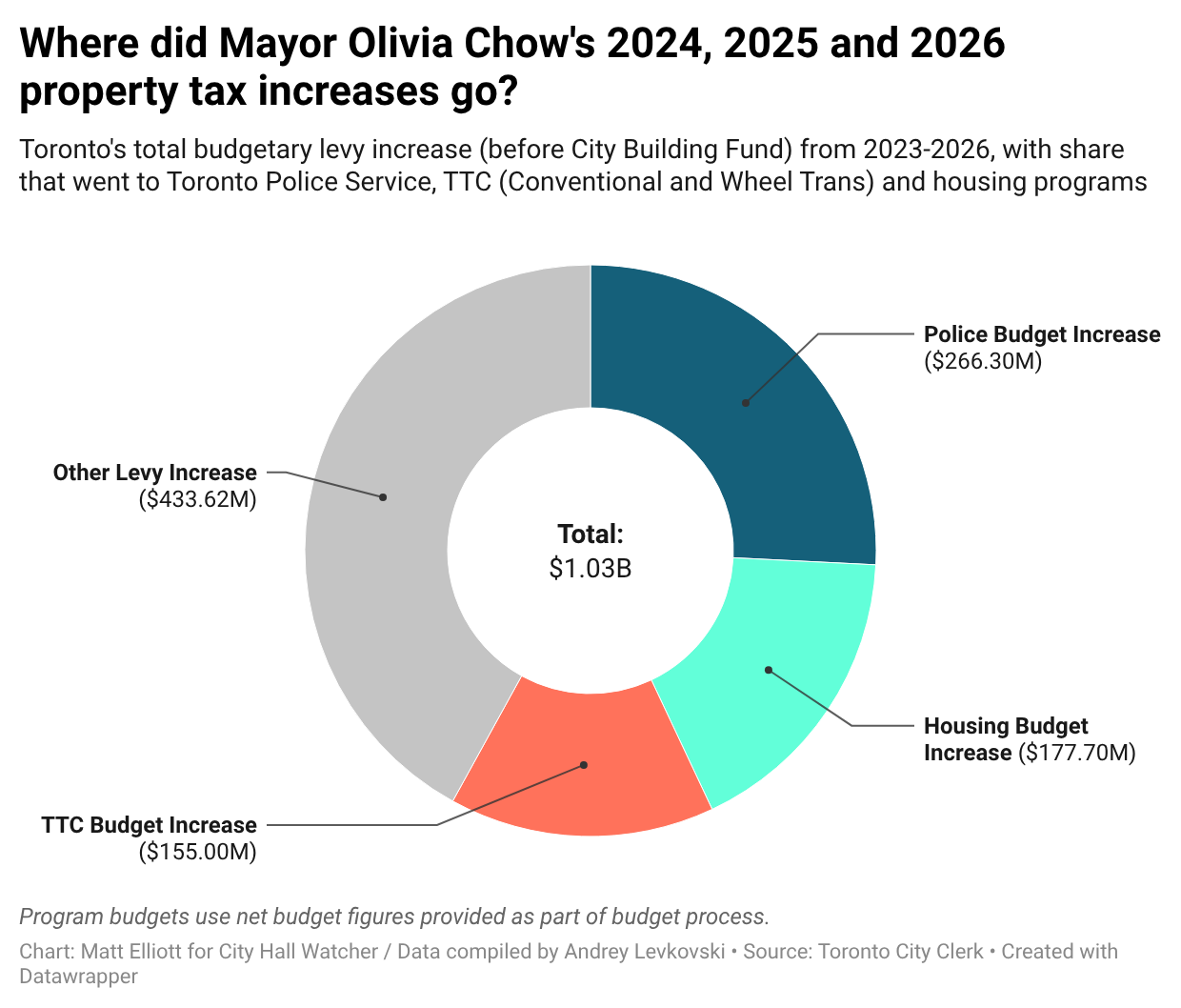
The police received the largest operating budget increase among the three major services examined: policing, housing, and transit. The City’s combined housing net budget grew from $420.1 million in 2023 to $597.8 million in 2026, an increase of $177.7 million. The TTC’s net budget rose from $1.3256 billion to $1.4806 billion, producing an increase of $155 million.
The police increase was therefore $88.6 million larger than housing’s and $111.4 million larger than the TTC’s. The housing figures combine the programs brought together in the City’s reorganized 2026 housing office, while the TTC figures include conventional transit and Wheel-Trans.
All three services received substantial increases, with police getting the largest.
Sean Meagher, executive director of The Change Lab and a longtime Toronto police budget analyst, said public safety had staunch support from residents and many councillors. Chow’s budgets reflected that democratic pressure, he said.
The extra police money largely bought people and compensation. TPS told CHW that negotiated salary increases, their annualization, inflation and employee benefits drove much of the growth. The 2026 police budget included a $50.7-million collective agreement impact and $20.5 million for 143 net new uniform officers. The City approved 212 additional police positions that year.
Meagher also pointed to money secured beyond the property-tax base. The Ontario-Toronto New Deal provided up to $1.2 billion in provincial operating support and transit funding. A federal partnership announced this month offered Toronto about $2.7 billion in housing grants and low-cost financing.
Capital budget documents reinforce Meagher’s point. The police’s rolling 10-year capital plan rose from $726 million in 2023 to $1.296 billion in 2026, an increase of $569.7 million. Both totals include carry-forward funding. Over the same budgets, the TTC plan grew from $12.491 billion to $16.657 billion — an increase of $4.166 billion. The City’s current capital plan also directs $5.183 billion to housing, supplemented by $3.577 billion in foregone revenues.
Police response times improved as budgets rose
On the operating side, police received a substantial increase across Toronto’s 2024, 2025 and 2026 budgets. One measure of police performance is how quickly officers responded to the most urgent calls.
Average Priority 1 response time fell from 23.1 minutes in 2023 to 17.1 minutes in 2024 and then to 14.1 minutes in 2025. Those results cover Chow’s first two budgets. TPS credits increased staffing, targeted deployment and operational changes. Its 2025 annual report also points to Next Generation 911, automatic text replies for disconnected calls and better queue management. In reality, total calls for service fell by 205,761, or 11%, in 2025.
At the same time, the 2023 police budget funded 336 hires, including 200 uniform officers and 20 communications operators. The 2026 police budget says the current expansion builds on hiring that began in 2022. The chronology shows response times improving during a period of rising budgets and overlapping operational changes. The earlier hiring likely contributed to the response-time improvement alongside Chow-era staffing increases, deployment changes, new 911 technology and falling call volume.
Several changes arrived together, making the improvement a shared result.
Meagher says the lasting test is whether Toronto keeps shifting suitable calls to services with the training to handle them.
“You can’t fill a bucket with no bottom,” he said. As police expand into work beyond their core role, he argues, added officers can be consumed by added tasks. Dispatch changes, new 911 technology and call diversion all helped bring response times down alongside hiring.
Civilian services can take work off the police
Toronto already has one major service helping to divert calls away from police. The Toronto Community Crisis Service sends civilian teams to people experiencing mental-health crises and gives 911 dispatchers another response option.
In 2025, TCCS received 4,482 eligible 911 transfers and resolved 76.7% without police involvement. The City projects annual diversions from 911 rising from about 5,300 in 2026 to more than 10,000 by 2031. Meagher sees the same potential in TTC Community Safety Ambassadors, youth outreach workers and stronger mental-health supports. Each program can reserve officer time for emergencies and investigations.
“You can free up more police officers by removing them from non-police work than by just spending more,” he said.
The TCCS, however, is a significant additional expense for the City, and police spending has continued to grow even as civilian teams take on thousands of calls, leaving no corresponding reduction in the police budget.
Police spending is set to keep rising
The current outlook keeps police spending rising through Chow’s hiring plan. The official figures put net spending at $1.564 billion in 2027, about $131 million above 2026, followed by a further $101.8-million increase in 2028. The hiring plan adds 87 net new officers and 29 civilian professionals in 2027, then 50 officers and 17 civilians in 2028.
As CHW previously covered, mayoral candidate Councillor Brad Bradford has proposed going further by hiring 1,000 new officers during his first term. Using TPS’s 2026 budgeted rate of $20.5 million for 143 net new officers, CHW estimated that 1,000 net new officers would cost about $143.4 million. Bradford has yet to explain how he would fund the plan.
With Chow’s hiring plan continuing and Bradford proposing an even larger expansion, police spending is likely to remain a major pressure on Toronto’s future budgets. Chow is likely to keep facing criticism for the property-tax increases approved during her tenure. The budget record makes policing’s place in that debate clear: for every additional dollar in Toronto’s annual general municipal levy, the police budget grew by about 25 cents.
In other news
By Andrey Levkovski
ROBOT, CHECK MY PERMIT: The City launched a new AI-powered tool on Thursday that checks building permit applications before they are formally submitted. The Building Permit Application Pre-Check scans eligible applications for missing or incomplete information, inconsistencies, and some zoning and Ontario Building Code issues, then produces a report applicants can use to fix problems before City staff begin their review. More than one in five Toronto building permit applications arrive without basic required paperwork, according to TorontoToday. The City says the pilot is intended to cut down on avoidable resubmissions and speed up first reviews.
TARIFF WARS, TORONTO EDITION: The renewed Canada-U.S. trade fight is becoming a Toronto mayoral campaign issue. Mayor Olivia Chow spent Thursday highlighting the City’s existing business-support programs, including the EDGE tax incentive. Its first recipient, National Dry Beverages, is spending more than $18 million expanding its North York plant and says it will add 20 jobs. Councillor Brad Bradford is promising a 25-per-cent property tax cut for roughly 3,500 industrial businesses while the trade dispute continues. The proposal was previously estimated to cost about $30 million annually. Neither candidate presented entirely new ideas, notes Toronto Today’s Aidan Chamandy. Chris Alexander, meanwhile, is pitching a two-year commercial property tax grant for qualifying new businesses, along with loan guarantees and lower licensing fees.
A MASS OF CYCLISTS: Hundreds of cyclists filled Toronto streets Friday evening for a large Critical Mass ride organized amid renewed fights over bike lanes. Mayor Olivia Chow joined the gathering and spoke before riders travelled along Danforth Avenue, past mayoral rival Brad Bradford’s constituency office and toward Queen’s Park. Estimates from participants put attendance somewhere from roughly 700 to more than 1,000. The ride came two weeks after the Ontario Court of Appeal cleared the way for the province’s planned removal of protected lanes on Bloor, Yonge and University, and after Bradford promised to remove the Bloor West lanes in Etobicoke if elected mayor.
THE RACE AT THE END OF AUGUST: A new Pallas Data poll has Chow at 38% among all voters, Bradford at 30% and Alexander at six percent, with 24% undecided. Among decided and leaning voters, Chow leads Bradford 50 to 39. The poll surveyed 808 Toronto voters from August 19 to 21. There’s an interesting wrinkle beneath the horse-race numbers: 48% said they were dissatisfied with Chow’s performance, compared with 37% who approved. Pallas CEO Joseph Angolano argues Bradford has yet to convince dissatisfied voters that he is a credible replacement.
The poll has been added to City Hall Watcher’s Election Projection site.
More from Matt: on team building, and trash bins
📰 For the Toronto Star last week, I wrote about the work Mayor Olivia Chow has been doing to build a team for a potential second term. Her focus on team-building seems to stand in pretty stark contrast to Councillor Brad Bradford’s lone wolf approach. If he did win, who would be on Team Bradford?
🗞️ For the Star this week, I tackle a question I’ve been seeing a lot lately: what’s this election actually about? Maybe, I argue, it should be about garbage bins. They’re more important than you think.
Look for it in your favourite newspaper.
The week at Toronto City Hall
THURSDAY: 🦧 The Zoo Board meets. They’ll hear some not-so-great news about attendance. Visits in July were way below budget. The month stands as “the fourth lowest July attendance in the Zoo’s 52-year history (including years affected by the COVID-19 pandemic).” Not ideal! The report blames the hot weather and wildfire smoke for making people think twice about spending a day outdoors looking at animals.
NEXT WEEK: More signs of life! The Preservation Board meets Wednesday. The TO Live Board meets on Thursday.
Weekly wrap
📽️ ELECTION PROJECTION: City Hall Watcher’s Election Projection currently gives Mayor Olivia Chow about an 80% chance of winning re-election. View the full projection by Alex Olson.
Recent additions include a very cool visualization of the most likely outcomes: Is the mayoral race going to be a nail-biter or a landslide? The data offers clues.
📊 CouncilScorecard.ca ACCESS CODE: Subscribe to get access.
🗳️ CANDID CANDIDATES: The 2026 Election Candidate Tracker remains available.
🪧 SIGNS OF THE TIMES: 1005 KING ST W: Tim Hortons; 60 SCOTTFIELD DR: Yee Hong Hospice; 1182 KING ST W: Fs8; 64 BATHURST ST: Equinox; 2876 DUNDAS ST W: Mcdonalds; 117 BLOOR ST E: St. Andrews United Church; 30 MUTUAL ST: Ac Hotels; 42 DUFFLAW RD: Toronto Foundation For Student Success; 1080-1082 ST CLAIR AVE W: Mizzica; 3250 MIDLAND AVE: Molly Tea; 1780 MARKHAM RD: Punjabi Haveli; 794 GERRARD ST E: Anytime Fitness; 1 OAK ST: 1Oak Dental; 294 EGLINTON AVE W: Crock A Doodle; 2304 SHEPPARD AVE W: Tim Hortons; 709 QUEEN ST E: McDonalds; 0 REXDALE BLVD: Big Chicken; 1849 YONGE ST: Davisville Medical Dental Centre; 26 LEE CENTRE DR: Shonan Sandwich & Sweet; 438 NUGGET AVE: Burger King; 801 BAY ST: Infinity Mart; 2299 YONGE ST: Poulet Rouge; 1289-1411 LAWRENCE AVE W: Metro; 260 YONGE ST: Simons; 356 HURON ST: Tianjin Auntie’s Bun Restaurant; 0 GIBBS RD: West Square; 333 BAY ST: Shinji; 2197 BLOOR ST W: 850 Degrees Pizzeria; 1090 DON MILLS RD: Crock A Doodle; 1090 DON MILLS RD: The Golden Hive. (Sign Permit Applications since August 24, 2026)
City Hall Watcher #399
Thanks for reading! Next week: a milestone! We’ll mark 400 issues with a wild party and also a summary of lobbying activity from August. It’ll also finally be time to debut SIMCOUNCILLOR.
This marks Andrey’s last issue of City Hall Watcher, as he wraps up his work placement. Thanks to him for all his contributions. It’s been a bunch of nerdy fun.
See you next week! Because of the holiday, the issue will hit your inbox on Tuesday.
Re: Bike kanes/"war on cars"
A standard, curbside parking space is 176ft2
Residential parking permits in Toronto cost $27.49/month
Average rent for a small studio apartment in Toronto is $1,720/month
An average studio apartment in Toronto is 441 ft2
441/176 = 2.51
$27.49 x 2.51 = $69
So anyone claiming there's a war on cars can put it where the sun don't shine!
I’m not sure the TTC calculation is correct. You need to look at how much the city subsidy to the ttc changed, not the ttc budget.
The frozen fares for chows term meant 500m$ more in subsidy between 2023 and 2026…