

Hey there! The World Cup has kicked off and, so far, the City seems to be handling things pretty well. I would have liked to see Team Canada score at least one more goal, but that’s not really a matter for the municipal government.
Anyway, while the soccer action continues, today I’ve brought you a story from frequent contributor Damien Moule about another kind of action: hot housing action.
Damien’s got a look at the major changes to the planning process that will come after Premier Doug Ford’s government passed Bill 98, the “Building Homes and Improving Transportation Infrastructure Act.” It will force the Council elected this October to make some big changes to the Official Plan — I sure hope they’re ready.
Also in this issue: I’ve launched an archive project that collects 17,000+ posts I’ve made during meetings of Toronto City Council over the last 15 years. Did it make me question my life choices? Never.
Speaking of life choices: thanks for choosing to read this newsletter. This issue is being sent out for FREE, but if you want to get this kind of municipal nerdery each and every week, consider becoming a paid subscriber. You’ll be supporting independent local journalism — and that’s a very cool thing to do.
✨ This issue runs a bit long. If it gets cut off in your email client, read it on the web.
— Matt Elliott
graphicmatt@gmail.com / Archives / Subscribe
Doug Ford’s Bill 98 will bring major changes to Toronto’s Official Plan — council candidates should know all about it
By Damien Moule
Toronto is a housing-obsessed city. Polling routinely shows it as a top issue in the city. Some of the key moments at City Council this term were housing fights that drew petitions with thousands of signatures and hours of deputations at committee. So surely a provincial law that upends housing and land-use planning, passed during a municipal election, would not go completely unnoticed by the candidates, the media, and pretty much everyone else, right?
…Right?
You may have heard about Bill 98, the Building Homes and Improving Transportation Infrastructure Act, which received Royal Assent on June 2. The bill got a decent amount of press coverage, mostly about the transportation parts. It gives the Ministry of Transportation the ability to set and harmonize transit fares in the GTA, set service standards, and require service on some routes. Some people are worried about that. Toronto City Council, in particular, is worried about that.
The bill also removes requirements for sustainable building design, such as EV charging requirements or bird-friendly window coatings, beyond what’s required by the Building Code. Some people are worried about that, too.
If you are reading a newsletter about Toronto municipal politics and policy, there’s a good chance you are the type of person who also follows news about provincial legislation and that you knew all of that. But if you followed along the main coverage of Bill 98, you might not have read anything1 about the most important aspect of Bill 98: it is the largest change to municipal land use planning in Ontario in decades.
What’s changing?
Land use planning is notoriously complex and dry, but stick with me for a few minutes here before scrolling down to Matt’s updates on happenings at Council. I want to convince you that the changes coming as a result of Bill 98 are a top municipal election priority and that you should be asking prospective councillors about it when they come knocking on your door.
Let’s start with the Official Plan. Remember that? The document which dictates which type of buildings will and won’t be allowed where, as well as transportation and infrastructure policies, community facilities and more?
Bill 98 requires Official Plans for large municipalities in Ontario to have a standard format and contents which do not remotely resemble Toronto’s current Official Plan. So the Official Plan has to be completely rewritten by August 2030, i.e. within the next municipal term.
Along with the standard format will come standard land use designations. These are the tools that every municipality uses to structure which types of buildings are allowed where. Things like neighbourhoods, mixed-use areas, parks, commercial, etc. For each designation, there are associated Official Plan policies about how development will or won’t proceed in those areas.
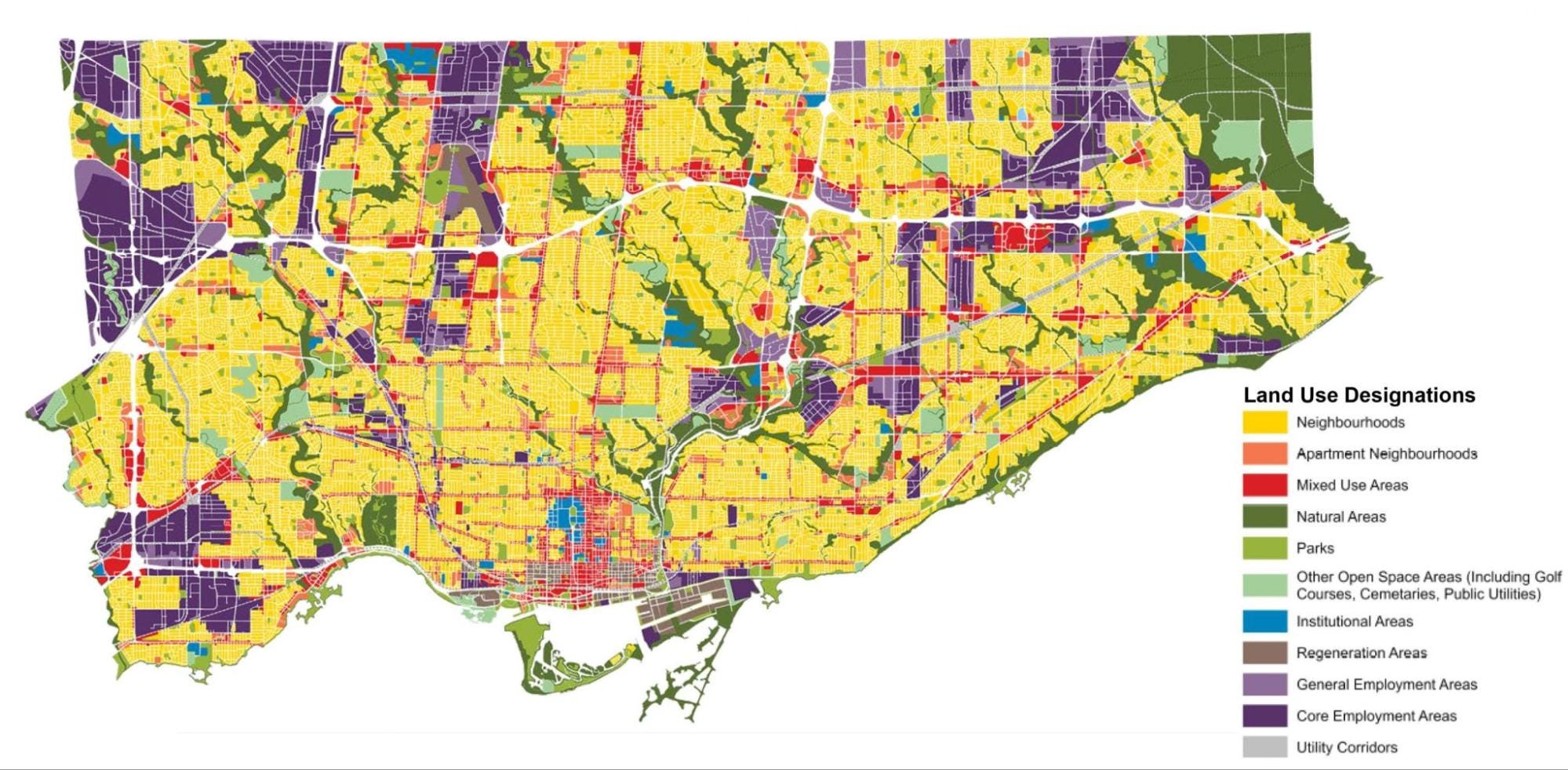
Three of Toronto’s land use designations, Apartment Neighbourhoods, Institutional Areas (for things like hospitals, universities, government buildings, etc.), and Regeneration Areas (formerly industrial areas that are being redeveloped), do not appear in the new standard list provided by the province. These categories will soon go poof, and their associated policies will either need to be removed from the Official Plan or rewritten for another category. There will also be several new categories, most notably “Major Facilities,” that the city will need to define and create policies for.
There’s more! Several new proposed regulations under the Planning Act were also posted to the Environmental Registry of Ontario alongside Bill 98 to support its changes. And these regulations would upend many policies in the current Official Plan.
The first two proposed regulations relate to standardized submission requirements for a complete development application and to potentially large revisions or the elimination of Site Plan Control. I have been reliably informed by friends and family that no one cares about any of the words in the previous sentence, but the upshot is that they will significantly reduce the number of reports, studies, and plans that the City can require developers to submit from 20+ to roughly ten.
The main way the City applies its Official Plan policies is by requiring developers to demonstrate that their proposed buildings are consistent with those policies. Removing the requirement to produce the reports removes the City’s ability to check that the policies were implemented, and so effectively removes a host of Official Plan policies. For example, City Council will have to find new ways to throw literal shade at new developments, because they will no longer be able to require shadow studies.
I will mention two more policy proposals that came along with Bill 98, though I know I’ve pushed my luck with your attention. One is looking at secondary plans and site-specific policies. It may upend the priority given in the Official Plan to local planning exercises over city-wide policy. The other is a change to population and employment projection methodology that will likely increase the amount of housing that Toronto will estimate that it needs.
A maximum minimum
Finally and more importantly, Bill 98 caps the minimum lot size that a municipality can require in urban residential areas. The cap is set by regulation, which the Ministry has proposed at 175 m2. For those wondering what that looks like, a typical lot size for a semi-detached Victorian bay-and-gable in the old City of Toronto is roughly2 6 m by 30 m, or 180 m2.
The required minimum lot sizes in Scarborough, North York, and Etobicoke are mostly between 300 and 600 m2, with some notable outliers like the required lot size of 8,000 m2 in the Bridle Path3. What this means in practice is that lot severance will be allowed4 and feasible in most of Toronto’s residential areas5.
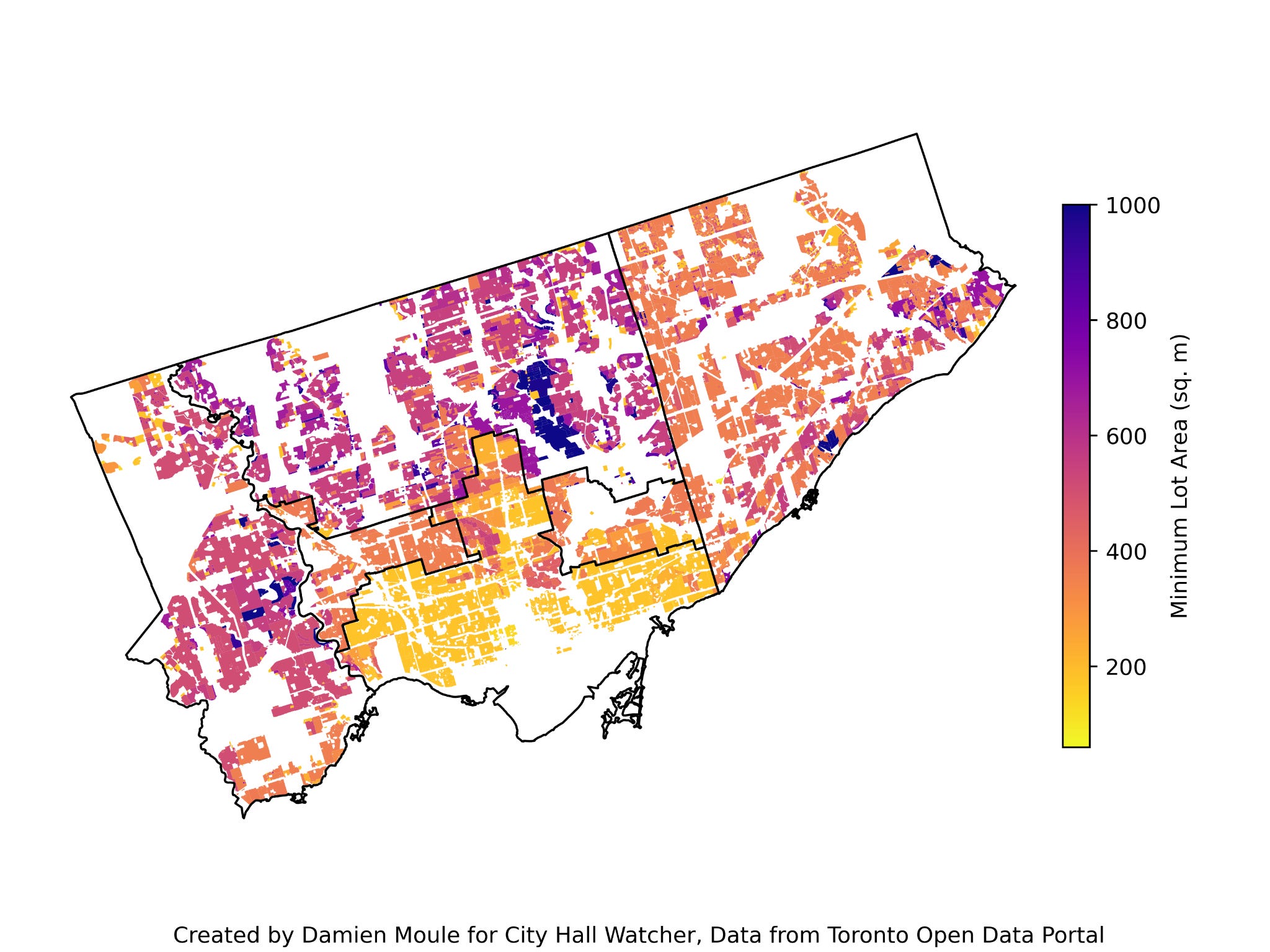
Why am I talking about this after yammering on about the Official Plan? The current Official Plan land use designation for low-rise residential areas is called capital-N Neighbourhoods. The policies for Neighbourhoods are the conceptual centre of the entire Official Plan. The Plan states that Neighbourhoods policies take priority over everything else. Every other land use category has policies to limit the impact on nearby Neighbourhoods. The key feature of Neighbourhoods policy is that they are meant to be physically stable, and that any development will respect the prevailing character, including in terms of lot size, building type, scale, and density.
With lot subdivision allowed throughout the city, recent changes in Toronto zoning to allow multiplexes, and Major Transit Station Area zoning mandated by the province, the guarantee of physical stability and prevailing character in Neighbourhoods will be gone. Smaller lots with narrower houses — different from the others on the street — and multiplexes will be allowed everywhere. Neighbourhoods near transit will allow midrise apartments. The centre of the Official Plan will fall through.
This is a Big Freaking Deal
Taken together, Bill 98 and its related regulations mean that not only will the Official Plan need to be reorganized to the new standard format, but that many of its policies will have to be removed or reworked, including those at the heart of the Plan. The land use maps will all need to be remade as well.
It would be pointless to try to smash the remnants of the current Official Plan into the new format. City Planning should start from scratch. And because zoning and other features of land use planning in Toronto implement the Official Plan, it seems likely to me that an Official Plan overhaul would be a first step towards an overhaul of those by-laws as well.
Now, to put my cards on the table, I am a fan of the proposed land use regulations under Bill 98. The current post-amalgamation Official Plan has been in place since 2002, and in my estimation, it has been a generational failure6. Housing affordability in Toronto began to deteriorate quickly after it was first adopted. Despite the good intentions of its authors, it has made thousands of people homeless, put a strain on the household budgets of hundreds of thousands more, hurt the local economy, and is deeply unfair. I think the Official Plan desperately needs a reform that will allow more housing in more places, and Bill 98 and the proposed regulations, especially around minimum lot size, will promote that.
But even if you don’t share my perspective, the Official Plan will need to be rewritten, and the councillors elected this fall will be the ones responsible for designing the process to replace it.
Bill 98 has taken restrictions on many types of low-rise development off the table and put limits on what can be asked of developers. Other provincial actions have made high-rises near transit an inevitability. There is a more standardized set of planning tools. But it will still be up to Council to make something good with them7.
This is a once-in-a-generation exercise to create the most important document for the most important municipal power. It will affect the well-being of millions of people for decades. Candidates for office should know that it will happen. They should list it as a priority. You should expect them to be able to answer questions8 about it and outline their vision for the new Official Plan. Anyone who can't shouldn't be elected.
Damien Moule is an engineer, municipal policy nerd, Ward 10 resident, father, and member of More Neighbours Toronto. You can find him on Bluesky at @damienmoule.bsky.social.
City Hall Watcher LIVE collects and archives 15+ years of Council coverage
By Matt Elliott
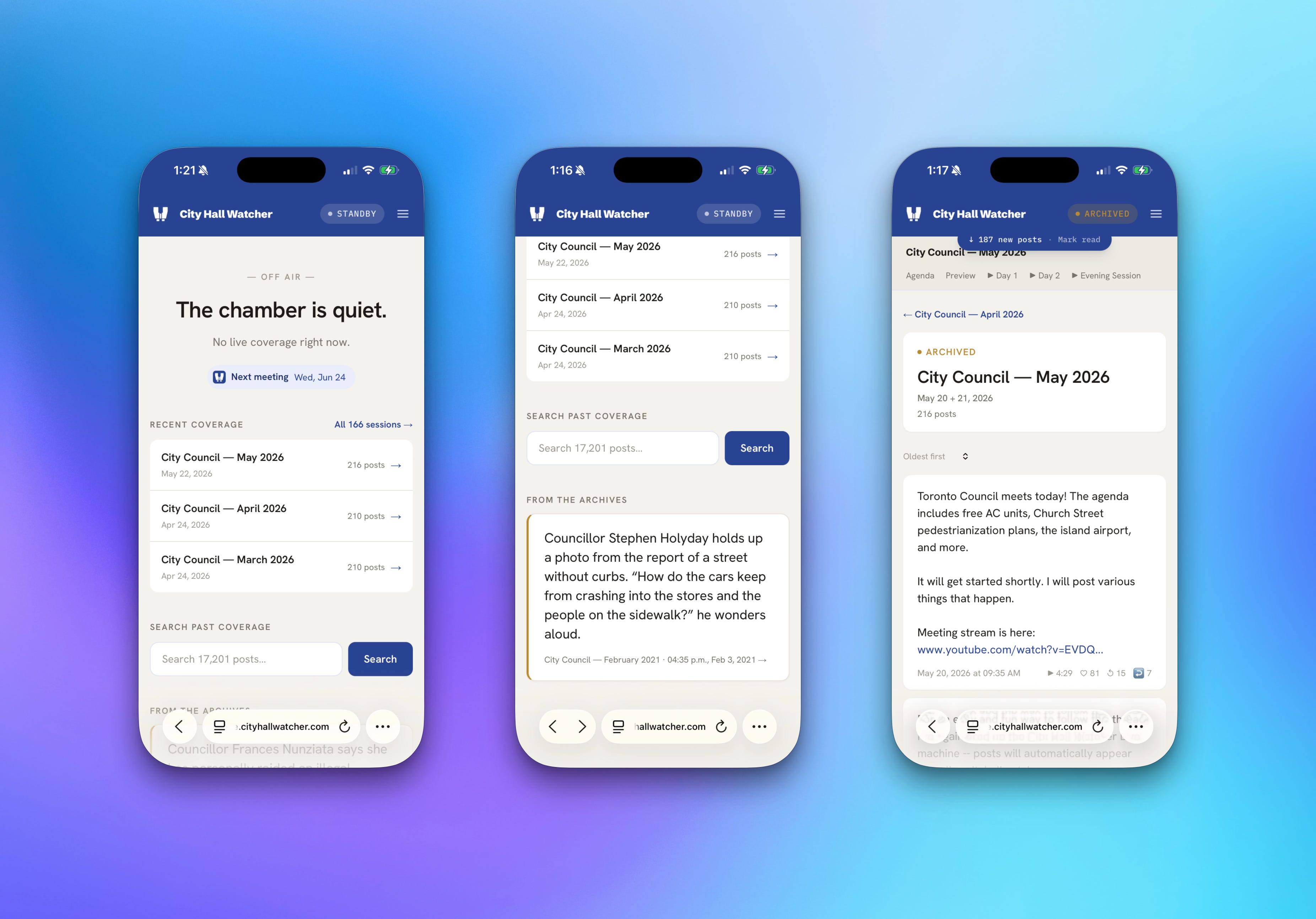
For the last couple of Council meetings, I’ve been testing a web app that automatically collects my live coverage on Bluesky and posts it to live.cityhallwatcher.com. People have told me it’s been useful as a simple way to follow the proceedings.
I’ve spent the last couple of weeks refining the app. The design has been updated. There’s a new feature that should let you keep track of your last-read post. Images display better.
In recent meetings, you’ll even see links on each post that take you to the approximate timestamp in the YouTube meeting video that aligns with my coverage. And I’ve coded in lunch break detection, so you’ll know when councillors took lunch. Groundbreaking.
But here’s the really big addition: I’ve collected and archived every thread of Council meeting coverage I’ve ever posted.
That’s nearly 15 years of meeting threads. It’s 166 meetings. It’s 17,201 posts. It’s a hell of a lot of use of the word “CARRIES.” It spans my complete evolution as someone who covers local politics — starting out snarky and more opinionated and ending all gruff and world-weary.
There’s a complete archive. It’s searchable, too. My favourite feature is probably the “From the Archives” section on the main page, which surfaces a random quote on every page refresh. Beware: it’s addictive.
I’m not delusional enough to think that a lot of people are going to want to go back and read my coverage of the debate on removing the Jarvis bike lane, the decision to strip Rob Ford of his mayoral powers, the chaos that ensued after Council got word that Doug Ford was going to cut half their jobs, or the first strange COVID-era virtual meeting.
But as Twitter has transformed into X and become more locked down for users who aren’t logged in — and also more generally unpleasant to use — I’ve become increasingly worried about one day losing access to the archive of information from the years I was only posting my coverage to Twitter. So now it’s got a home. A permanent one, I hope.
I need your help, though: with so many threads and posts, I can’t possibly review this whole thing by myself. I am looking for any reports of anything that appears broken, janky, or missing.
Features I am working on:
Swapping the screenshots of vote results for a more readable, accessible vote card display.
Councillor tagging, so you can easily find all posts related to a member of Council.
Making this an open-source project.
Let me know if there’s anything else that would be useful.
➡️ Access the complete coverage archive and follow along LIVE when Council meets at live.cityhallwatcher.com
More from Matt: on making nice for the World Cup, and the half-baked airport expansion plan
📰 For the Toronto Star last week, I wrote about the City’s push to make things really clean and nice for those attending the FIFA World Cup. The improvements are appreciated, but I’m still wondering why it takes a mega event to motivate a major municipal effort.
🗞️ For the Star this week, I write about the latest on the island airport expansion effort. The provincial and federal governments have us talking about a plan that doesn’t even exist. That shouldn’t fly.
Look for it in your favourite newspaper.
The week at Toronto City Hall
MONDAY: ♿️ The Accessibility Advisory Committee met. They got an update on staff’s work to assess the feasibility of providing a real-time central dispatch system for accessible taxis. Currently, people looking for an accessible ride generally need to book with Wheel Trans in advance, which limits the spontaneity. The update says work is ongoing, with a complete report due in Q1 2027.
🎭 The TO Live Board met. They reviewed the results of a consultation process with performing arts groups about the current state of the St. Lawrence Centre for the Arts. “Participants felt that the centre is tired and in need of an upgrade,” the presentation says, but the same groups are also worried that upgrades will require a prolonged closure — they want to make sure they get at least 18 months’ notice before any shutdown.
Also on the agenda: TO Live CEO Clyde Wagner wants to hike the facility fee charge added to tickets by a dollar. The move is expected to raise about $500,000.
TUESDAY: 🗄️ Mayor Olivia Chow’s Executive Committee meets.
They’ll hear that Toronto residents are bonkers for barrels, apparently. An initial offering of free rain barrels was fully claimed in just nine hours.
To offer more barrels of fun, the mayor has a motion to spend another $238,249 — offset by revenue from Toronto Water — to provide another batch of barrels. To make things fairer, the mayor is also recommending limiting the program to one barrel per household this time. (Previously, households could snag two.)
Also on the relatively light agenda:
The committee will be asked to endorse the construction of a new library branch in the Quayside community on the waterfront.
At Council’s request, Toronto Hydro has put together a report on its work to support the development of multiplex housing. They note the number of multiplexes they’ve connected to power has been on the rise, from 129 in 2024 to 179 in 2025. This year, they’re on pace to connect about 200.
A summary of donation activity shows the City received 6,450 individual donations totalling about $1.08 million in 2025. Most were donations made to Animal Services and the Commemorative Tree & Bench Program.
WEDNESDAY: 🐕 The Dangerous Dog Review Tribunal meets. They’ll consider a much-delayed appeal regarding a muzzle order in 2022 issued to Poodle mix Kaibo.
THURSDAY: 🎢 The Exhibition Place Board meets. A report on the agenda looks at whether the Exhibition grounds would be a good place for a casino, and concludes it would not be. “Overall, the available evidence suggests that introducing new casino opportunities may lead to adverse public health and community impacts, particularly for vulnerable populations,” the report says.
The temporary casino operated during the CNE will continue to be allowed to operate, though.
🥖 The Francophone Affairs Advisory Committee meets for the final time this term. They’ll review a list of city departments and agencies that offer some services in French. Reps from the Bureau du Québec à Toronto will also be in attendance to give a presentation. Ooh la la.
FRIDAY: 🪧 The Sign Variance Committee meets. The Nobu Hotel on Mercer Street is looking for approval to put illuminated “NOBU” signage atop the building. But city staff are saying no to Nobu, citing the building’s “significant residential component.” Mixed-unit buildings have different rules regarding signs than office buildings, apparently.
🏗️ The CreateTO Board meets. They’ll consider a request to hire a consultant to compare the cost of building affordable housing in Toronto with costs in other cities. Could be useful.
NEXT WEEK: Council meets, starting on Wednesday.
Weekly wrap
📊 CouncilScorecard.ca ACCESS CODE: Subscribers can access the current code here.
🗳️ CANDID CANDIDATES: The 2026 Election Candidate Tracker has been updated — and now includes a handy map view.
🪧 SIGNS OF THE TIMES: 30 HIGH MEADOW PL: C; 234 MARKHAM RD: North Kabab; 3463 KINGSTON RD: Charging Station Electrical Design; 4211 YONGE ST: 4211 Yonge St; 2220 BLOOR ST W: TD Canada Trust; 234 MARKHAM RD: Afghan Bakery; 1235 WILSON AVE: Hennick Humber Hospital; 1623 QUEEN ST W: Revertsconnect; 85 ELLESMERE RD: McDONALDS; 571 BLOOR ST W: Mirvish Village; 373 FRONT ST E: Canary Landing West Cherry House; 831 GLENCAIRN AVE: Pizza Nova; 2870 EGLINTON AVE E: McDonalds Restaurant; 3571 SHEPPARD AVE E: Healthy Planet; 755 ROYAL YORK RD: Ecole Elementaire Catholique; 10 PLASTICS AVE: Topomath.Ca; 7431 KINGSTON RD: McDonald’s; 2507 YONGE ST: Flight Centre; 220 YONGE ST: R.W & Co; 1 THORA AVE: Vaultra Storage; 152 PARK LAWN RD: Tim Horton’s; 5418 YONGE ST: California Beef Noodle; 50 JOHN ST: Rosemont Residences. (Sign Permit Applications since June 8, 2026)
City Hall Watcher #388
Thanks for reading! And thanks to Damien for his contribution. If you’ve got an idea for some analysis or reporting on a municipal matter, don’t hesitate to send me a quick pitch.
If you enjoyed this issue and you’re not yet a subscriber, I hope you’ll consider joining us. Subscriptions are just six bucks a month or 60 bucks a year, plus tax — it’s a bargain and a deal.
For subscribers, I’ll be back next week to get you set for the second-to-last Council meeting of the 2022-2026 term. Be warned: I am planning to use the word PENULTIMATE a lot.
The only coverage on that topic that I saw was from John Michael McGrath at TVO (who I encourage you to read), and his article was in part about how no one was talking about it.
The lot sizes in the Victorian era were not created in metric units. This is rounded from a lot size of 20 feet x 100 feet.
No, that’s not a typo.
I do need to emphasize the difference between allowed and required. Urban planning practice over the past few generations has kept zoning closely tied to the existing built form. So much so that people in housing debates often forget that you can allow things to be built, but that does not mean that they must or will be built.
The map includes both minimum lot sizes explicitly mentioned in a lot’s zoning, as well as the default values that apply to the individual residential zones (RD, RS, R, etc.). There are some nuances to the defaults around semi-detached buildings and townhouses, but for what I’m discussing in this newsletter, it is precise enough. Also note that I have capped the scale at 1000 m2 for visualization purposes.
Also to blame are other Official Plans in the GTA, along with previous revisions of the Planning Act that enabled them all to exist in their restrictive and unresponsive forms.
City councillors love complaining that the Ontario Land Tribunal exists and that it essentially forces them to approve development applications that are consistent with the current Official Plan even when there is strong local opposition. I would suggest to them that if they don’t like approving the buildings that they said they wanted in the Official Plan, now is the chance to write a different Official Plan. Though that means they will have to pick the types of new buildings that would be allowed and where they will go, and some councillors don’t want to do that.
For candidates or voters looking for ideas on process or content, I would point them towards Edmonton. In 2018, Edmonton started a two-year process to create a new City Plan. It followed that three years later with a new zoning by-law to implement the plan. In my opinion, the City Plan cemented Edmonton’s place as the city with the best housing policy in the country.
@Damien Moule bravo to cards on table...Excellent article
The City of Toronto's so called "official plan" is now so full of exceptions... and exceptions to the exceptions - That it is essentially meaningless and (just as importantly) toothless.
Add to this Ministerial exemptions, and the lost battles at LPAT/OLT and the City has lost any semblance of control it may once have had.
City Planners using "conformity to the plan" as a criteria would be laughable, were it not for the tragic consequences to those of us forced to live in its shadow.
The density minimums (technically minima) are also somewhat arbitrary and seem to speak to suburban sprawl and not the realities of downtown density.
In fairness that is also the fault of a City that seeks hyperlocal downtown intensification instead of graduated intensification across all wards. (You can intuit the ward/community council boundaries from Damien's excellent map)
I'm skeptical of a "City Plan" that attempts to reconcile the cosmopolitan needs of Toronto Centre (21k people per square km) with the delightful Cow Pastures, Cornfields and Provincial Parks of Scarborough Rouge Park. (1860 people per square km)
I completely agree that the best candidates in the upcoming election should be completely current on this brief - Personally, I'd look for different skill sets, sophistication and (not to mince words) competence - depending on ward impact.
I've taken a look at the Edmonton model for city planning and agree that it checks a lot of boxes in terms of inclusionary housing. But not to sound cynical, Edmonton is not the same as Toronto in terms of scale, density, urban issues or cultural complexities - Its also not in a realpolitik partisan proxy Cold War with the Province.
With this in mind I'd like to add a set of downtown candidate qualifications:
A deep understanding of urban planning... and hand to hand combat.
"It spans my complete evolution as someone who covers local politics — starting out snarky and more opinionated and ending all gruff and world-weary."
Aren't you like 40 or something? If that's the case that's a pretty compressed timeline. Where the hell are you going to go from there in the next 40 years? 🤣🤣🤣